Menu engineering explained: stars, plowhorses, puzzles, and dogs
Menu engineering classifies every dish by profit margin and popularity, then acts on each type. Done consistently it adds 10–15% to the bottom line. Here is how the framework works.
· 8 min read
Menu engineering is the practice of classifying every menu item by two dimensions — profit margin and popularity — and then taking a specific action on each category to grow overall profit. It is one of the highest-return levers in hospitality: applied consistently, menu engineering adds 10–15% to a restaurant's bottom line, verified across independent industry sources.
The reason it works is concentration. Around 80% of sales typically come from just 16% of menu items. A handful of dishes carry the business, a handful quietly drain it, and most sit in between. Menu engineering finds which is which, and tells you what to do about each.
The four categories
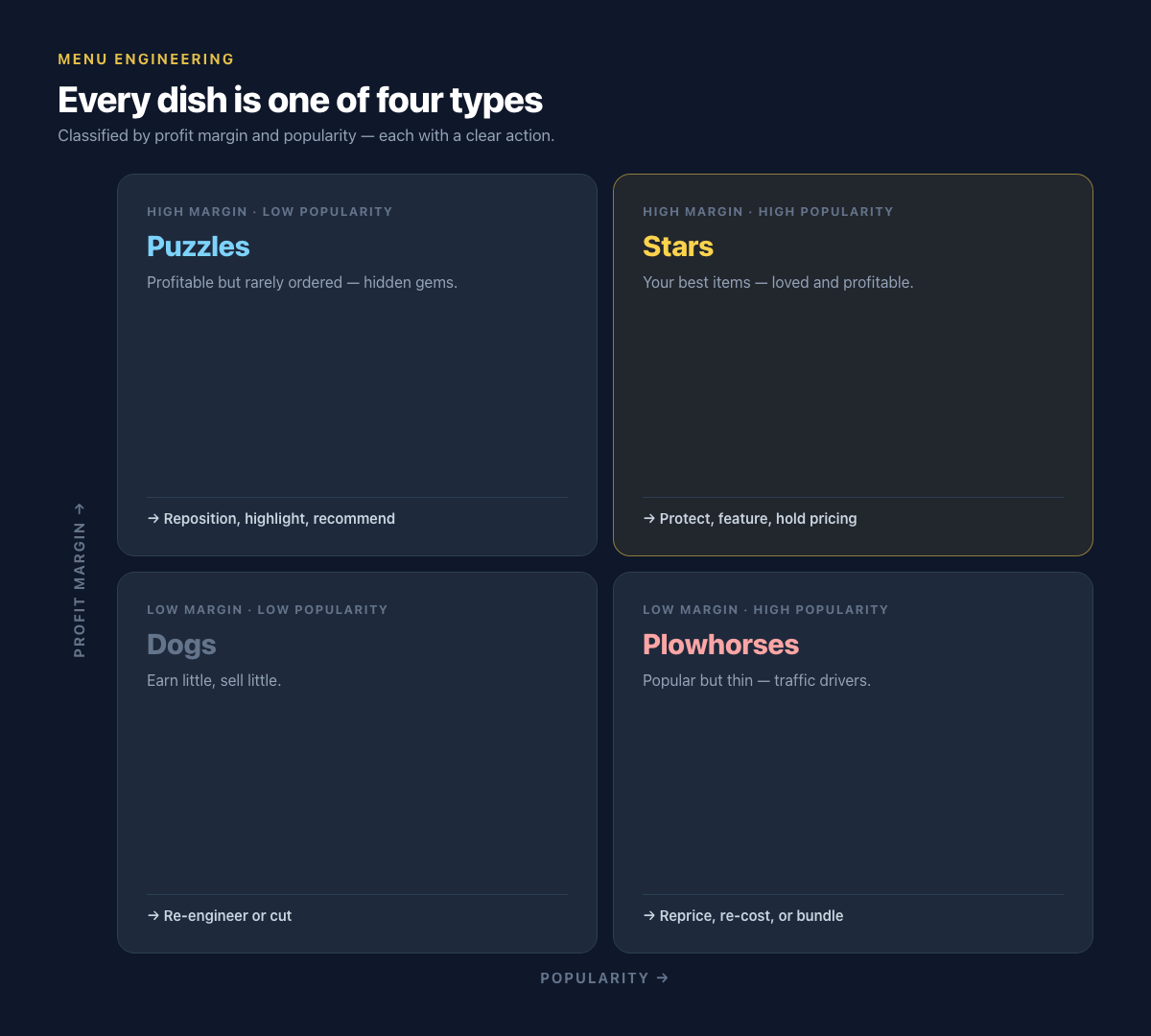
Plot every item on a grid of margin (high/low) against popularity (high/low) and you get four types, each with a clear action:
- Stars — high margin, high popularity. Your best items. Protect them, feature them prominently, and hold their pricing. Do not discount a star.
- Plowhorses — high popularity, low margin. Loved but barely profitable. Raise the price slightly (a 5–10% increase is usually absorbed), re-cost the recipe, or bundle them with a high-margin item.
- Puzzles — high margin, low popularity. Hidden gems that few people order. Reposition them, highlight them visually, and train staff to recommend them. Moving one puzzle from 2% to 10% of sales can add several points to profit.
- Dogs — low margin, low popularity. They earn little and sell little. Remove them or completely re-engineer the recipe and positioning. Cutting dogs also simplifies the kitchen and reduces waste.
How to classify an item
Popularity is measured against the menu average — a common rule is that an item selling at 70% or more of the average item's sales counts as "popular". Margin is the contribution margin: selling price minus food cost, in actual currency, not just a percentage. An item can have a high margin percentage but a small cash contribution, so look at both. With item-level POS data these calculations are straightforward.
Acting on the classification
The value of menu engineering is in the actions, not the grid. A few proven moves:
- Placement — put high-margin items (stars and the puzzles you want to promote) in the menu's "Golden Triangle", the zones the eye lands on first. This alone lifts selection by around 60%.
- Visual emphasis — boxing an item or adding an icon or image raises its selection by roughly 18%. Reserve this for high-margin items.
- Repricing — nudge stars and popular plowhorses up 3–5% where demand is not price-sensitive; test which puzzles are held back by price versus awareness.
- Bundling — pair a low-margin plowhorse with a high-margin item; combos reach 35–50% of orders and add $4–6 to average order value.
- Removal — cut the dogs. Around 54% of restaurants have already trimmed menu items to control cost; a shorter, sharper menu usually sells better.
The multi-venue complication
For groups, a star in one venue can be a dog in another — 68% of multi-unit operators struggle with inconsistent menu performance across sites. The answer is a hybrid: a standardised core menu of 20–25 proven items plus a handful of location-specific choices. Standardising the core alone has delivered around a 12% margin improvement for multi-unit operators.
How intraQ does menu engineering for you
The classification and the actions all depend on item-level sales and margin data — exactly what intraQ reads from your POS. It can rank every item by contribution and popularity, flag the stars, plowhorses, puzzles, and dogs, and surface the basket pairings worth bundling, all from a plain-English question. Instead of a quarterly spreadsheet exercise, the menu matrix stays live.
Frequently asked questions
What is menu engineering? It is classifying menu items by profit margin and popularity into four groups — stars, plowhorses, puzzles, and dogs — and taking a targeted action on each to increase overall profit. Applied consistently it adds 10–15% to the bottom line.
What are the four menu engineering categories? Stars (high margin, high popularity), plowhorses (low margin, high popularity), puzzles (high margin, low popularity), and dogs (low margin, low popularity). Each has a distinct recommended action.
How much does menu engineering improve profit? Verified across independent sources, consistent menu engineering adds roughly 10–15% to a restaurant's bottom line, driven by better margins on existing sales rather than more footfall.