Does a loyalty programme actually pay off? The economics for hospitality
Loyalty members spend 12–25% more and a well-run programme returns 35–65% in year one, rising past 150% from year two. Here is how the economics actually work — and where they go wrong.
· 8 min read
A hospitality loyalty programme pays off when it increases how much members spend and how often they return by more than it costs to run. The verified economics are strong: loyalty members spend 12–25% more annually than non-members in restaurants (around 22% more in hotels), and a well-executed programme returns 35–65% in its first year and 150–300% or more from the second year onward. But those returns depend on design and engagement, and it is easy to get wrong.
This is the honest version of the economics — the uplift, the ROI curve, the cost of retention versus acquisition, and the traps — using figures that survived independent verification.
The spend and frequency uplift
Loyalty works on two levers at once: members spend more per visit and visit more often.
- Members spend 12–25% more annually than non-members in restaurants; hotel members spend around 22% more.
- Loyalty now accounts for about 39% of restaurant visits — roughly double the share it held in 2019.
- Repeat visit rate improves 15–20% in year one, and 40–60% from year two as members build the habit.
- Guest lifetime value rises 20–30% in year one and 80–120% in later years.
The ROI curve
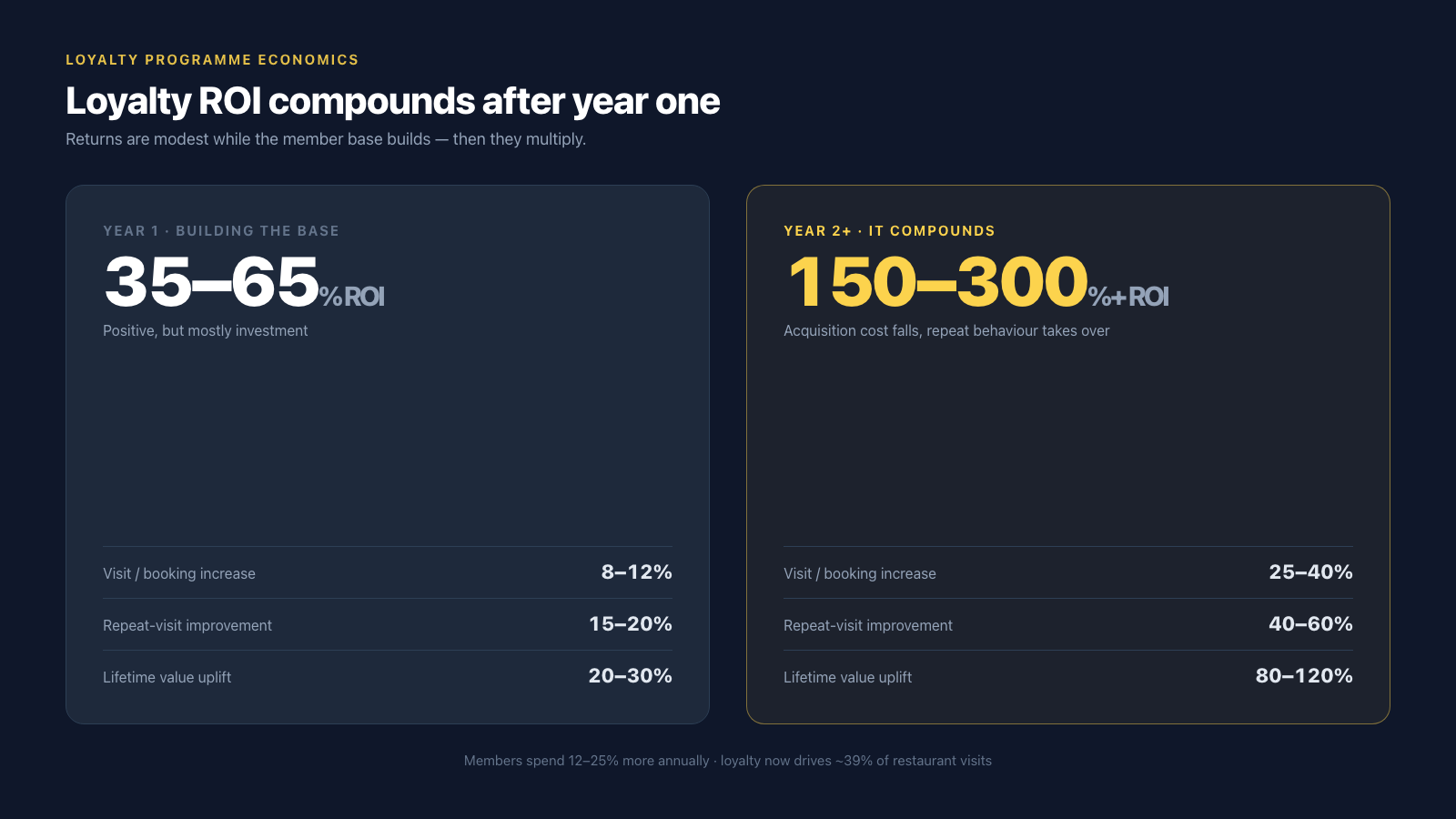
Loyalty ROI is not flat — it compounds. Year one is largely about building the base, so returns are positive but modest. From year two, acquisition costs fall away and repeat behaviour takes over:
- Year one ROI: 35–65%, with an 8–12% increase in direct bookings or visits.
- Year two and beyond: 150–300%+ ROI, with a 25–40% increase in direct bookings.
- Meaningful impact on lifetime value and repeat rate becomes visible after 6–12 months — so treat year one as an investment, not a test to abandon early.
Why retention beats acquisition
The deeper reason loyalty pays is the economics of retention. Keeping an existing customer is far cheaper than winning a new one, and existing customers are also more willing to try new menu items — which makes them the ideal audience for launches and premium add-ons. A relatively small retention improvement compounds into a large profit gain, though the exact figure depends heavily on your margin structure.
The signs of a healthy programme
Two numbers tell you whether a programme is working. Redemption rate should sit in the 15–25% band — below that, members are not engaged or the reward is unclear; above it, the rewards may be too generous and eroding margin. And watch perceived value: a large share of younger members report seeing no instant benefit in loyalty schemes, so a programme has to deliver something visible early or enrolment never turns into behaviour.
Making loyalty data-driven with intraQ
The biggest waste in loyalty is the blanket discount that erodes margin without changing behaviour. The alternative is targeting — using the transaction data intraQ already holds to segment customers by recency, frequency, and spend, then offering each segment the thing it is actually likely to buy.
This is where intraQ is proactive rather than passive. It does not wait for you to run a report — it flags the gap. For example, it can surface a loyalty member spending $12 a visit when their segment averages $18, identify from basket data that they buy coffee and pastry but rarely together, and prompt you to offer that member a targeted combo instead of a generic discount. Their average order value rises, and they keep choosing you over a competitor. Because existing customers are more likely to try new products, new-item and premium pushes should target loyalty members first. intraQ surfaces which members are slipping, which segments are most valuable, and which offer is worth making — then measures whether it worked, turning a generic points scheme into a targeted, self-correcting revenue lever.
Frequently asked questions
Do restaurant loyalty programmes actually increase revenue? Yes — verified figures show loyalty members spend 12–25% more annually than non-members, and loyalty now drives about 39% of restaurant visits, roughly double its 2019 share.
What is the ROI of a hospitality loyalty programme? A well-run programme returns 35–65% in year one and 150–300% or more from year two, as acquisition costs fall and repeat behaviour builds. Meaningful impact appears after 6–12 months.
What is a healthy loyalty redemption rate? Between 15% and 25%. Below 15% suggests low engagement or unclear rewards; above 25% may mean the rewards are too generous and cutting into margin.